
Increased Scrutiny Ahead as GAO’s LDA Audit Highlights Noncompliance
Amidst one of the busiest times for federal lobbyists, the Government Accountability Office released its annual audit of compliance with the Lobbying Disclosure Act (“LDA”). The audit serves as a reminder that compliance (or non-compliance) with the LDA and other lobbying laws still receives significant attention, and that as lobbyists are busy helping clients navigate the CARES Act and other stimulus-related provisions, compliance should not take a back seat.
LD-203 Non-compliance
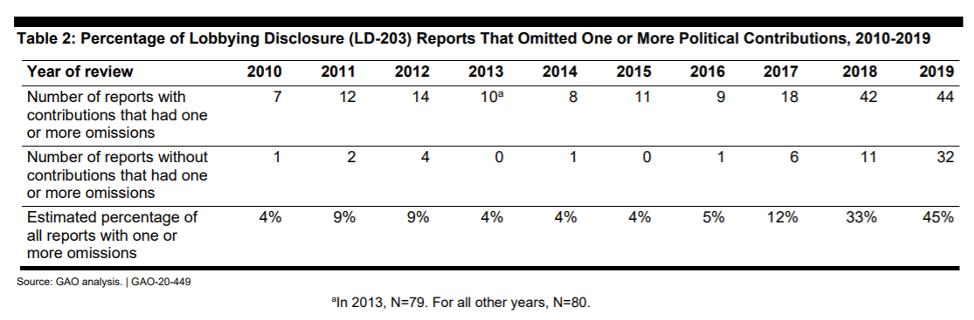
While the GAO audit notes that most lobbyists and their clients file registrations (LD-1s) and quarterly reports (LD-2s) in a timely manner, noncompliance has increased significantly, when it comes to compliance with political contribution reports (LD-203s).
Specifically, the GAO audit found that 45% of LD-203 reports had at least one contribution missing in 2019. This was a statistically significant increase, up from 2018’s 33% high-water mark.
As the report noted, GAO’s audit measured the error rate based on crosschecking publicly reported political contributions appearing on the FEC’s website with those on the LD-203. GAO also stated: “Going forward, these results suggest we examine further the extent to which lobbyists fully report political contributions.” Adopting a compliance program, like the ones we perform for clients that includes a similar crosscheck of public records, can help ensure that your lobbying operations do not get caught up in the rising non-compliance numbers of future GAO audits.
In addition, the audit also points out the continued referral of non-compliant lobbyists to the United States Attorney’s Office (“USAO”). One positive indicator on the compliance front, however, is that lobbying firms appear to have received the message on LD-203 compliance – with referrals of lobbying firms to the USAO have dropped from 263 in 2017 to 77 in 2018. Individual lobbyists, on the other hand, still have room for improvement – referrals to the USAO for LD-203 non-compliance for them had a small uptick from 784 to 854 over the same period. Another noteworthy finding on the enforcement front, the GAO audit found no instances of non-compliance with the JACK Act.
Finally, although it appears that most lobbyists properly disclose their covered positions as required by the LDA, lobbyists should be aware that the GAO performs its own independent search of “firms’ websites, LinkedIn, Legistorm, and Google” in its compliance check – a reminder to ensure that both your public profiles and your LDA should reflect accurate information.
Other Sources of Scrutiny
GAO itself has stated that it plans to increase scrutiny on lobbyist reporting, particularly LD-203 political contribution reports. But GAO’s audit is not the only source of pressure on lobbyists these days. For example, the House of Representative’s proposed third COVID-19 stimulus bill, HR 6379, included a complete ban on federal lobbying for corporations receiving aid until all such aid is repaid to the federal government. See Section 407(a)(5). Although the CARES Act did not ultimately include that provision, its presence in the House proposal signals that the House may push for increased lobbying restrictions and oversight in the future. Indeed, some House Democrats are already working on a proposal to impose those restrictions as part of a separate oversight bill of the $2 trillion stimulus package.

